What 20 Years in Zinc Die Casting Taught Me About Sourcing Smarter
Let’s be honest — if you’re still sourcing zinc die cast parts the same way you did five years ago, you’re probably leaving money on the table. I’ve been in this industry long enough to see trends come and go, but 2026 is shaping up to be different. Buyers aren’t just asking “what’s your price per piece?” anymore. They want to know about surface finishes, assembly, supply chain backup plans, and whether you can hold a cosmetic spec that would pass inspection in Tokyo or Stuttgart.
I run a zinc die cast company with factories in Xiamen, China, and Hanoi, Vietnam. Combined, we have about 20,000 square meters of production space. Over the years, we’ve made everything from bathroom faucets for TOTO to lock bodies for Master and beauty device housings that need to look flawless on a retail shelf. So when I talk about zinc die casting in 2026, I’m not quoting a market report — I’m sharing what actually happens on the shop floor.
Why Zinc Still Wins
Every now and then, a customer asks me why they shouldn’t just switch to aluminum or injection-molded plastic. The answer usually comes down to three things: precision, surface finish, and toughness. Die cast zinc has this unique ability to fill thin walls and intricate shapes while keeping dimensions incredibly stable. You can get threads, logos, and snap features right out of the mold. Try that with plastic and you’ll need inserts; try it with aluminum and your tooling costs might go through the roof.
We do a lot of zinc alloy die casting for parts that need both strength and a premium feel — think the weighty handle of a high-end faucet or the solid click of a lock mechanism. And because zinc melts at a lower temperature, our high pressure zinc die casting machines run longer between tool maintenance cycles. That means better consistency and lower long-term costs, especially for volumes above 50,000 pieces a year. I’ve seen tools in our shop still producing excellent zinc die castings after 500,000 shots.
The Thing Most People Overlook: Coating
Here’s something I wish more buyers thought about early on: the real magic often happens after the casting. A raw zinc die cast part is pretty unremarkable. It’s what you put on top of it that makes it survive salt spray tests, resist scratches from daily use, and catch a consumer’s eye.
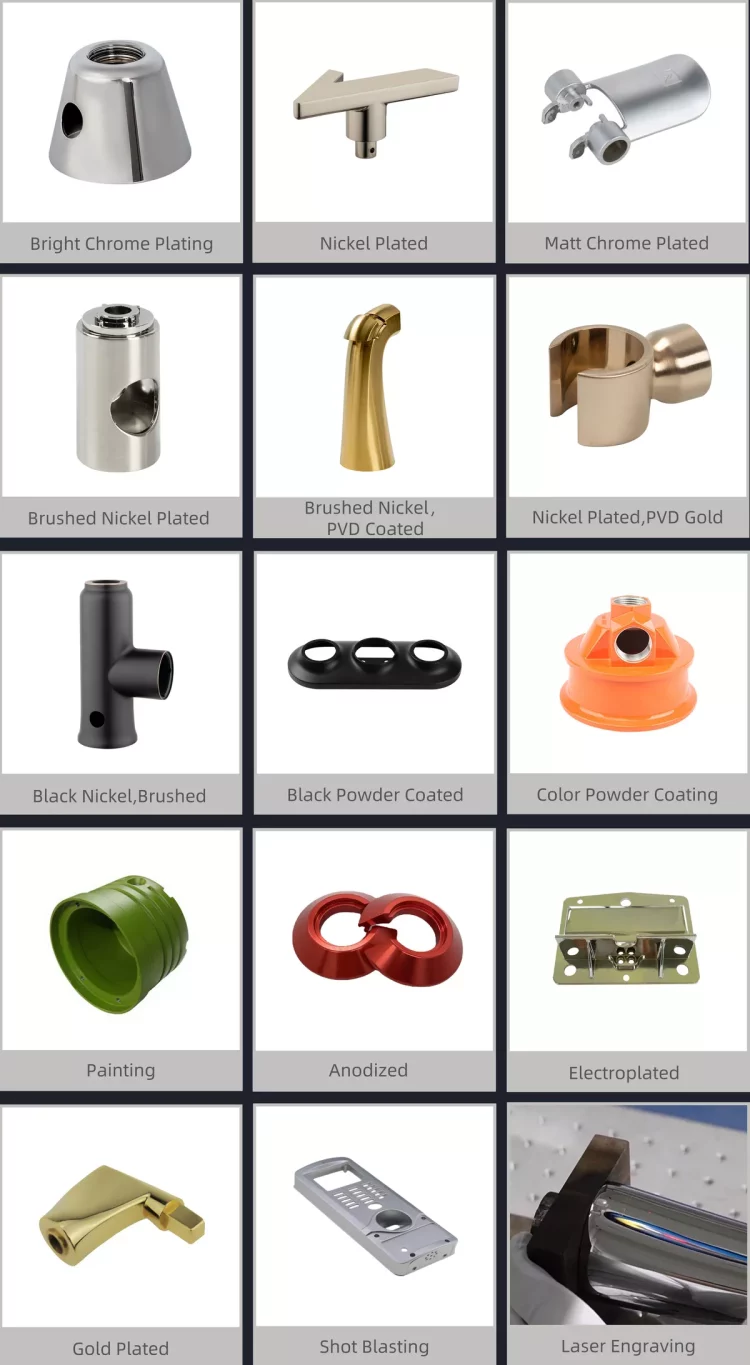
We invested in having electroplating, PVD, painting, and polishing all under our own roof for exactly this reason. When someone asks about coating for zinc die cast components, we can talk about real process control — not just pointing them to a third-party plater down the road. I remember a project for a European lock brand a few years back. They spec’d a satin nickel finish that had to survive 96 hours of neutral salt spray without a single blister. Because we controlled the pretreatment, plating chemistry, and drying steps ourselves, we hit the spec on the first try. If we’d outsourced the coating, I’m pretty sure we’d still be debugging it today.
Whether it’s a shiny chrome for a bathroom fitting, a PVD gold for a beauty device, or a tough powder coat for an outdoor lock, the best coating for zinc die cast applications comes from integrated lines. It also cuts lead times because you aren’t shipping parts all over town between processes. For our customers ordering zinc die casting components with cosmetic surfaces, that integration is often what seals the deal.
Quality That Survives a TOTO Audit
If you’ve ever been through a supplier audit by TOTO or Kohler, you know it’s not a friendly chat over tea. They go deep — material certifications, process parameters, CMM reports with CPK data, traceability records. We’ve been supplying zinc die cast parts and zinc die cast assemblies to names like these for years, so our quality system has been battle-tested. Japanese JIS standards, German DIN specs, US NSF requirements — they’re baked into our routines now, not just something we scramble to meet before a visit.
That kind of track record matters when you’re comparing zinc alloy die casting parts manufacturers. Anyone can send you a shiny sample. But can they deliver 10,000 pieces a month with the same cosmetic quality and zero assembly issues? Our internal rejection rate for visible surfaces is well below 0.5% on established programs. That doesn’t happen by accident.

What “Custom” Really Means
A lot of factories say they do custom zinc die casting, but what they mean is “send us your 3D file and we’ll make it.” In my experience, the real value comes much earlier. We have engineering teams in both Xiamen and Hanoi who sit down with DFM (Design for Manufacturability) reports and suggest tweaks that can save weeks of tooling rework. Things like changing a gate location so you don’t get flow lines on a visible surface, or adding a slight draft to eliminate a secondary machining step.
We’re not just a die cast zinc parts supplier either. Our CNC department handles tight-tolerance boring and threading, and we build complete zinc die cast assemblies — inserting stainless steel bushings, O-rings, springs, even doing laser engraving and packaging. A recent project for a medical device client involved 17 components in a single assembly. They started out managing four different vendors; now they manage one. That’s the kind of simplification zinc die casting services can offer when you pick a partner with depth.
Two Factories, One Standard
The China-plus-Vietnam strategy isn’t just a buzzword in 2026 — it’s a practical response to tariffs, shipping costs, and the need for business continuity. Our Xiamen site handles complex tooling development, prototyping, and some of the more demanding finishing like PVD. The Hanoi factory scales up for volume production of die casting zinc alloy parts, especially for customers who need CPTPP or EVFTA duty advantages.
Both plants follow the same quality playbook. I’ve personally walked the shop floors in both locations and I can tell you the control plans, work instructions, and even the color of the reject bins are identical. Tooling transfers between the two sites are something we do more and more often. If you’re looking for a zinc die cast company that can keep you running no matter what happens with trade policy, this dual footprint gives you options that a single-site factory simply can’t.
A Few Lessons on Picking a Partner
I’ve probably spoken to hundreds of procurement managers over the years. The ones who end up happiest with their zinc die castings supply base tend to look for a few specific things:
-
Integrated finishing matters more than you think. If you’re sourcing parts that need plating or coating for zinc die cast surfaces, ask to see the plating line yourself or get a video tour. A factory that owns its finishing is miles ahead.
-
Don’t judge by the office, judge by the defect rate. A fancy showroom means nothing. Ask for real quality data — first pass yield, cosmetic reject rates, salt spray test logs.
-
Assembly capability is a hidden cost saver. When your zinc die cast parts arrive ready to install, you cut your internal labor and reduce supplier management overhead. Even simple zinc die cast assemblies (like a lock body with a pre-installed latch) can streamline your production.
-
Ask about their “problem” stories. A good zinc die cast manufacturer will openly talk about past challenges and how they fixed them. If everything was always perfect, they’re probably not being straight with you.
Wrapping Up (and an Invitation)
At the end of the day, a zinc die cast component is a small but critical part of a bigger product. When it’s done right, nobody notices. When it’s done wrong — a leaky faucet handle, a lock that jams, a beauty tool with peeling plating — it’s all your customers remember. That’s why I believe choosing the right zinc die cast company is one of the most important decisions a hardware or consumer goods brand can make.
If you’re exploring a new project, comparing zinc alloy die casting parts manufacturers, or just curious about how a dual-location setup could de-risk your supply chain, feel free to reach out. We can talk through a DFM, send you a sample kit of our zinc die casting components, or set up a virtual tour of the Xiamen and Hanoi factories. Sometimes a 20-minute conversation answers more questions than a dozen white papers.
Contact STICK INDUSTRY today — let’s figure out if we’re the right fit for your next project.